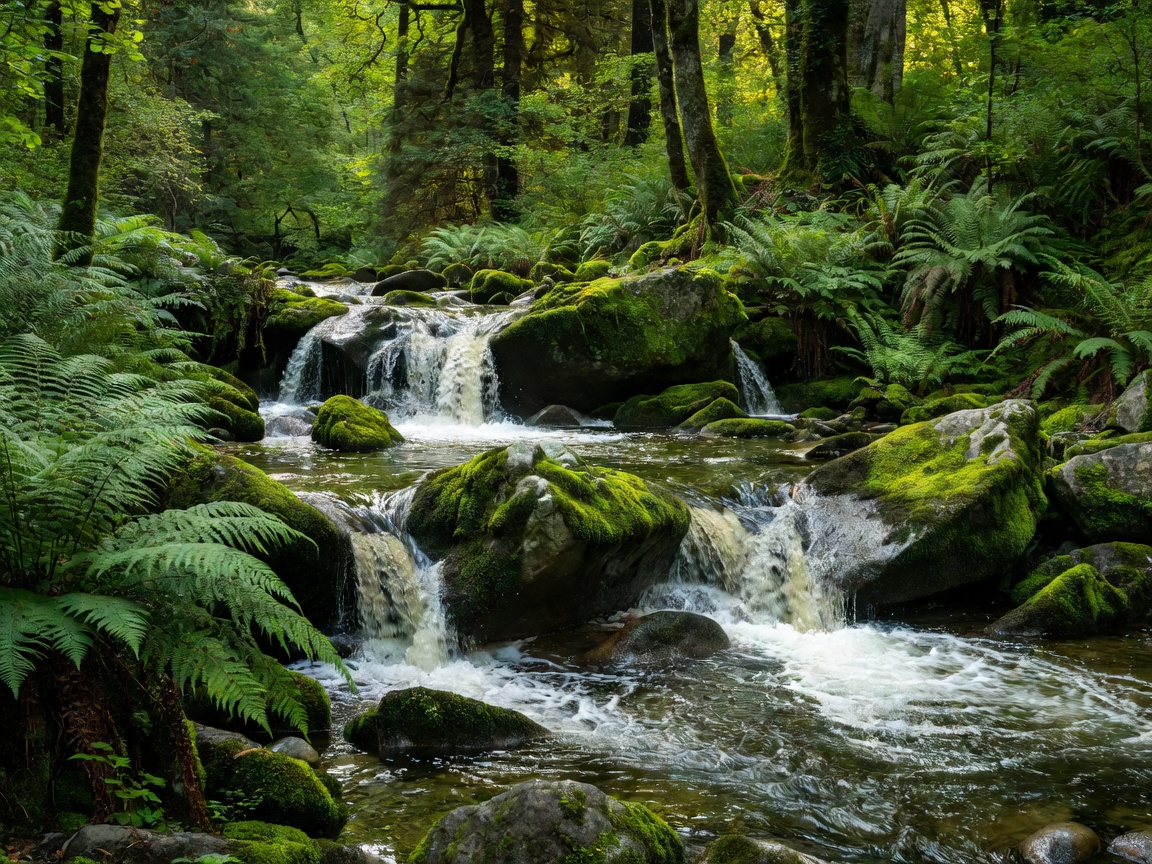
From Mountain Torrents to Sheltered Gorges
Northern Ireland boasts high annual precipitation that charges swift river valleys, sculpting deep ravines lined with Atlantic liverworts, wild ferns, and towering redwoods.
The Character of Atlantic Forest Woodlands
Few landscapes combine romantic 18th-century landscape design with untamed Atlantic forest ecology like the river parks of Northern Ireland. The western and north-eastern margins of the province benefit from a hyper-oceanic climate characterised by mild winters, cool summers, and sustained humidity. This atmospheric balance sustains rich communities of epiphytes, polypody ferns, and Atlantic mosses that carpet every tree trunk and granite boulder lining the water channels.
Whether walking the Shimna River in the foothills of the Mourne Mountains or tracing the Burntollet River through the deeply incised gorge of Ness Country Park, visitors experience ancient woodlands where historical stone bridges, stepping stones, and rushing spates create a tranquil sensory haven away from modern roads.
Spotlight: Three Distinguished Forest & Water Systems
Tollymore Forest Park (County Down)
Landscape Profile: Nestled at the foot of the Mourne Mountains, spanning 630 hectares along the fast-flowing Shimna River. Designed originally in the 18th century by James Hamilton, 1st Earl of Clanbrassil, featuring Gothic stone arches, hermitage shelters, and towering Atlantic redwoods.
- Key Features: The Hermitage viewpoint, the Stepping Stones river crossing, arboretum with the Clanbrassil fir.
- Practical Considerations: Vehicle entry fee applied at gate; popular during sunny weekend afternoons; well-marked gravel trails.
Glenoe Waterfall (County Antrim)
Landscape Profile: Tucked into a quiet, almost hidden limestone glen just south of Larne. Managed by the National Trust, the water cascades over a 10-metre sheer rock face into a deep, dark plunge pool surrounded by dense ferns and wild garlic.
- Key Features: Compact, high-impact natural amphitheatre; stone stairs offering mid-level viewing angles; free entry.
- Practical Considerations: Tiny car park holding fewer than 15 vehicles; steep, damp stone steps requiring careful footing; short walk (under 1 km).
Ness Country Park (County Derry/Londonderry)
Landscape Profile: Features Northern Ireland’s highest single-drop waterfall, set inside 55 hectares of mixed woodland along both sides of the Burntollet River gorge. Includes exposed rock cliffs and quiet riverside boardwalks.
- Key Features: Spectacular after autumn rainfalls; connects downstream to Ervey Wood; diverse bird life including kingfishers.
- Practical Considerations: Substantial flight of timber steps ascending from the gorge base; slippery timber treads in damp weather.
Detailed Trail Specification: Tollymore River Trail
The River Trail represents the finest balance of architectural curiosities and wild woodland scenery:
- Trail Grade: Moderate (firm gravel pathways, occasional granite rock steps, and bridge crossings).
- Length: 5.2 km circuit.
- Elevation Change: 115 metres total ascent.
- Key Waypoints: Main car park → Foley’s Bridge → The Hermitage stone alcove → The Stepping Stones → Horn Bridge → Return via arboretum.
- Footwear Recommendation: Supportive walking boots or water-resistant trail shoes with good wet-rock traction.
Safety, Water Spate Dynamics & Environmental Care
Mountain rivers like the Shimna and Burntollet have steep catchment basins. Heavy downpours in the high peaks can cause water levels to surge several feet within hours, transforming gentle bubbling cascades into violent brown torrents. When exploring river gorges:
- Never attempt stepping stones when water levels submerge their tops or when rocks are coated in green river slime.
- Stay behind safety rails near waterfall plunge pools. Currents under waterfall bases are notoriously turbulent with strong undertows.
- Protect native woodlands by cleaning soil from boots before walking to prevent the spread of fungal pathogens such as Phytophthora ramorum, which threatens larch and rhododendron canopies across Northern Ireland.